
Can your hot water cylinder go outside? Check the casing first
Outdoor siting is not decided by whether the tank is stainless steel, copper or enamel. It is decided by the cylinder casing, the pipe run back to the kitchen, and whether the unit can still be serviced properly.
Last reviewed 2026-09-08
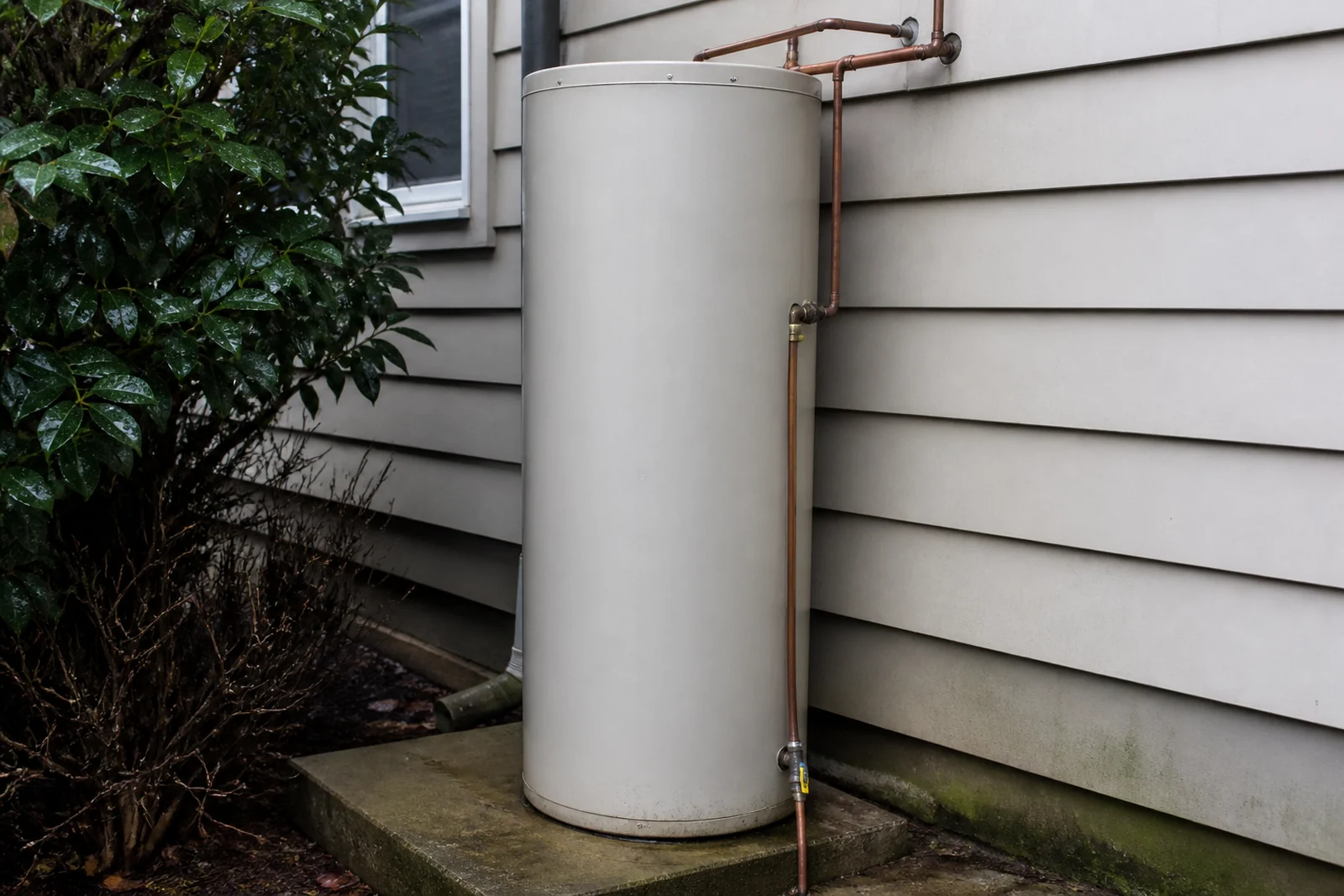
Whether a hot water cylinder can go outside is decided by the casing, not the tank inside it. The casing detail catches people out, because two cylinders can have the same stainless or enamel tank construction and only one of them may be rated for outdoor installation.
Think of it like a phone in a waterproof case. The phone might be expensive and well made, but if the case is not meant for rain, the phone should not be left on the deck. A cylinder is similar. The tank holds the water. The outer jacket is what faces the weather, and that jacket is often the difference between indoor only and indoor or outdoor.
This matters when a cylinder has failed and the cupboard looks awkward, too small, or badly placed. Moving it outside can sound like a tidy answer. Sometimes it is. Other times it creates a new problem, because the cylinder itself may not be outdoor rated, or the new pipe run may no longer fit the Building Code acceptable solution. The right answer is not just, can it fit there. The real questions are whether that model is rated for there, whether it can be serviced there, and whether the hot water pipe run is still acceptable.
The tank material is not the outdoor rating
The first thing to separate is the tank from the casing. The tank is the pressure vessel or water container. It may be stainless steel, copper, or enamel-lined steel. Vitreous enamel is a glass-like lining baked onto steel, used to help protect the steel tank from the water. Many enamel cylinders also have an anode, which is a sacrificial metal rod designed to corrode before the tank does. The anode needs room to be removed and replaced later.
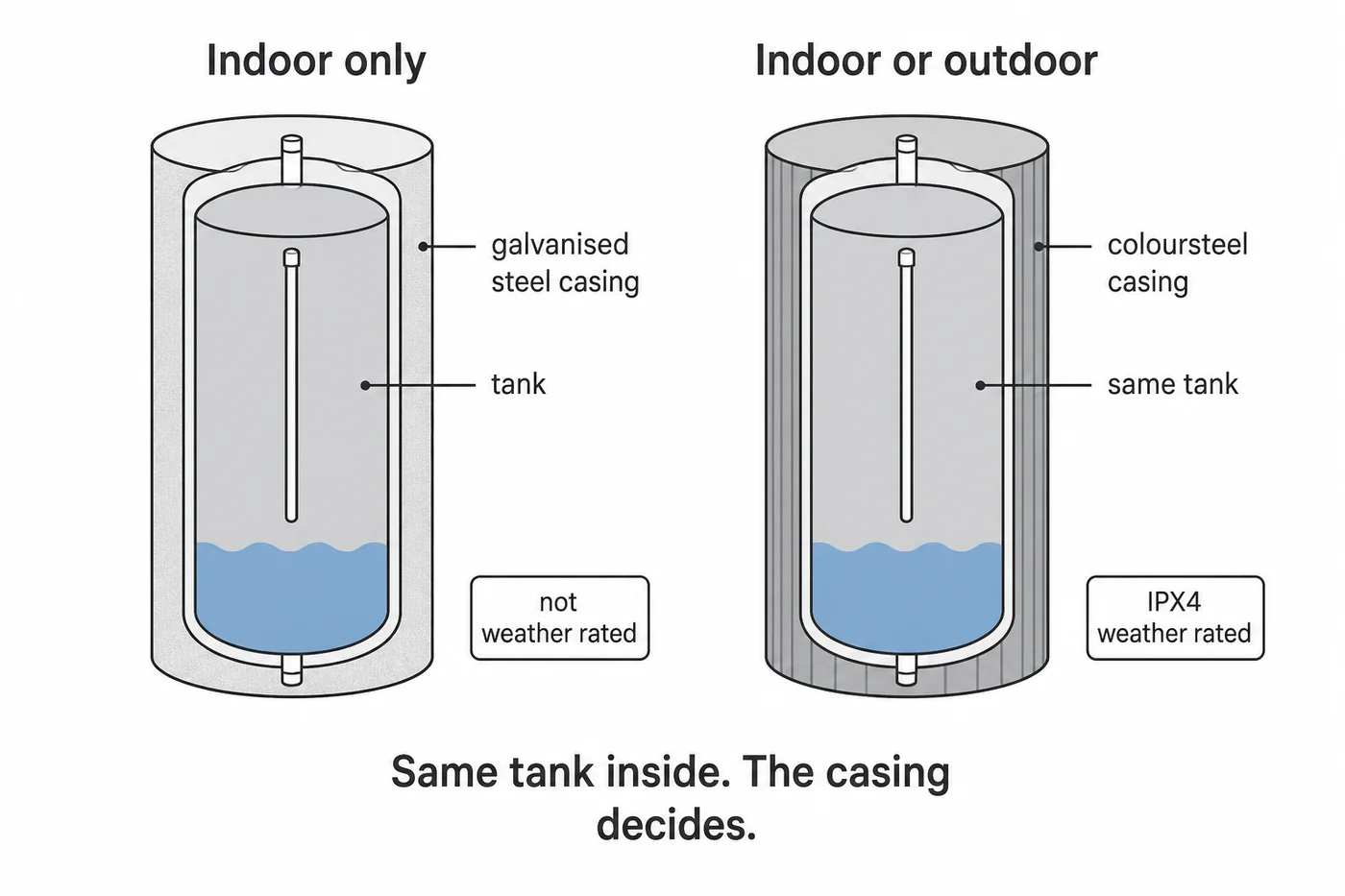
None of that automatically tells you whether the cylinder can sit in rain. The manufacturer’s siting rating does.
Rinnai enamel cylinders show the point clearly. Rinnai enamel indoor only cylinders have a galvanised steel outer casing. Rinnai enamel indoor or outdoor cylinders have a coloursteel outer casing with an IPX4 rating. The tank construction can be the same, but the jacket is different, so the siting rating is different.
Rinnai low pressure copper cylinders are another example. They have a galvanised outer, an IPX1 rating, and are indoor only. Low pressure systems are common in older New Zealand homes, and people sometimes focus on the copper tank. For siting, the key point is still the rating of the whole cylinder, including the outer casing.
Stainless steel creates another trap. Rinnai’s duplex stainless mains pressure range is rated indoor only. Stainless sounds tough, and people often assume it means weatherproof. Stainless steel does not mean weatherproof. Tank material and siting rating are two different questions.
Rheem state the same principle in their own way. Their electric water heaters with a galvanised outer casing are suitable for indoor installation only, while those with a factory painted casing suit both indoor and outdoor installation. Rheem outdoor models must sit on a hard level base with the supplied feet between the cylinder and the base.
One small detail is worth knowing before you order a compact outdoor unit. The Rinnai 30L indoor/outdoor unit needs its power cable in conduit or hardwired if it goes outside, because the cable is not UV rated. The cable requirement does not make it unsuitable for outdoors, but it does mean the outdoor installation details matter.
What we actually stock for indoor and outdoor siting
Across the Hot Water Sorted catalogue, the pattern is not one simple rule by tank type. Most Rinnai enamel cylinders we stock are indoor or outdoor. Rinnai stainless cylinders are indoor. Rheem stainless cylinders split into indoor lines and indoor/outdoor lines. Every low pressure cylinder we stock is indoor only.
The product’s siting rating is why it is risky to shop by the words stainless, enamel or copper alone. Those words tell you something useful about the tank, but they do not settle where the cylinder can be put. The product’s siting rating does that.
If your old cylinder is in a hallway cupboard and you want it moved outside, start with the siting field for the cylinder you are considering. If it says indoor only, treat that as indoor only. If it says indoor or outdoor, more still needs checking, but at least the cylinder rating is not the first obstacle.
The pipe run can be the bigger problem
The second surprise is that moving a cylinder can put the house outside the Building Code acceptable solution, even when the cylinder itself is outdoor rated. Quick advice often misses this part.
New Zealand Building Code H1.3.4 requires hot water systems to limit heat loss and to make efficient use of hot water. NZS 4305:1996 is the acceptable solution cited by clause H1. It sets three points that matter when you are choosing a cylinder position.
- Water heaters should be located as close as practicable to what they serve.
- The pipe to the kitchen sink must hold no more than two litres.
- The maximum run to a kitchen sink is 12 m at 15 mm or 7 m at 20 mm.
Those figures are not comfort advice. They sit inside the acceptable solution pathway. A long pipe run wastes heat, wastes water while you wait for hot water to arrive, and can make a perfectly good cylinder feel worse in daily use. The kitchen sink matters because it is usually one of the most frequent hot water draw-off points in the home.
The everyday version is simple. If the cylinder is beside the kitchen, the hot water has a short walk. If it is moved to the far outside wall, the hot water may have to travel down the hallway, around corners, through the ceiling or under the floor, and back to the sink. You do not see that pipe, but you pay for the heat sitting in it.
The limits are specific: 12 m at 15 mm or 7 m at 20 mm, and the pipe to the kitchen sink must hold no more than two litres. Do not guess this from a floor plan. The actual pipe route needs checking by a licensed person, because pipes do not always run in the straight line you would draw on paper.
Departing from NZS 4305 makes the work an alternative solution. On consented work, that needs council approval before the work. The approval question is not something to tidy up after the cylinder has been bought and put in place.
For buying, the practical lesson is simple. If the only outdoor position is a long way from the kitchen, the cylinder that suits the house may be an indoor cylinder in or near the existing position. Or, if you are considering a heat pump water heater, it may be a split heat pump system that leaves the tank where it is while placing the outdoor equipment elsewhere. The assessment belongs with your plumber or another licensed person, but the question belongs at the buying stage.
Indoor cupboards still need room around the cylinder
Keeping a cylinder indoors is not automatically easier. An indoor position often is easier, but only if the space still allows the unit to be installed, maintained and eventually replaced without pulling the house apart.
Serviceability is not just a courtesy to the next tradesperson. Serviceability is tied to warranty conditions. Rheem state that no warranty cost is payable where the cylinder is in a position that does not comply with their installation instructions and that forces major dismantling of cupboards, doors or walls, or the use of special equipment to bring it to a serviceable position.
The clearances are there for real parts that may need attention. Space must be allowed for TPR valve removal, element cover and element removal, and anode removal and replacement. The TPR valve is the temperature and pressure relief valve, a safety valve fitted to the cylinder. The element is the electric heating part. The anode, where fitted, is the sacrificial rod protecting an enamel-lined tank. If a cylinder is wedged hard into a tight alcove, servicing can become difficult or impossible, and that can cost the cover.
Dimensions also matter here. A cylinder that is only a few millimetres smaller than the cupboard opening may still be the wrong choice if the valve, element or anode cannot be accessed later. Before ordering, use the dimensions guide and check the actual space, not just the old cylinder’s nominal capacity. Two cylinders with the same litre size can have different heights and diameters.
Can a cylinder go in a roof space?
Roof space questions come up when people want the cylinder out of sight. Please do not climb into the roof space to take a photo for us. The risk is not worth it.
The two big issues are weight and access. A full cylinder is heavy. The structure has to be able to support it, and the route to get the cylinder into position has to be practical. Then the same serviceability rules still apply. A cylinder hidden in a roof space still needs access for valves, elements and, where fitted, anodes. The cylinder also needs to be reachable without unusual dismantling or special equipment that the manufacturer’s instructions do not allow for.
A roof space may sound neat because it saves cupboard space, but it can quickly become a poor maintenance position. A licensed person should check a roof space on site before you choose a cylinder around that idea.
Can a cylinder go under a bench?
Sometimes, but only small capacities are short enough. Under-bench spaces are usually shallow, low and surrounded by cabinetry, so the limiting factor is often physical size before anything else.
Measure the available height, width and depth carefully, then compare those measurements with the dimensions guide. Remember that the cylinder body is not the whole story. Pipe connections, valves, element access and future removal also need space. If a cupboard has to be dismantled every time the unit is serviced, that is not a good sign.
Under-bench cylinders can make sense for small demands or point-of-use situations, but they are not a magic way to hide a full-size household cylinder.
What about the garage?
A garage is usually the easiest alternative position. A garage is indoors, often provides more working room, and access is normally better than a cupboard or roof space. A garage can also suit a monoblock heat pump water heater.
A monoblock heat pump has the heat pump and tank together as one outdoor-style unit. A garage can be attractive because it gives room for the unit and for service access, depending on the model and the house layout. A split heat pump is different: the tank and outdoor heat pump section are separate. A split arrangement can help when you want the tank close to the kitchen or in the existing cylinder position, but need the heat pump section somewhere else.
If you are comparing those options, read the heat pump guide for monoblock versus split before choosing the cylinder position. The siting decision and the product type often need to be made together.
A simple order to check things
When you are under pressure because the hot water has failed, it is tempting to ask one yes-or-no question: can this cylinder go there? A better sequence will save time.
- First, check the product’s siting rating. Indoor only means indoor only. Indoor or outdoor means it may be suitable for either, subject to the rest of the installation requirements.
- Second, check the outer casing detail where it is relevant. Galvanised outer casings are commonly indoor only in the manufacturer information above, while the outdoor-suitable versions use the specified outdoor-rated casing.
- Third, have the pipe run to the kitchen sink checked. The NZS 4305:1996 acceptable solution figures are 12 m at 15 mm or 7 m at 20 mm, with no more than two litres in the pipe to the kitchen sink.
- Fourth, check service access. There must be room for TPR valve removal, element cover and element removal, and anode removal and replacement where applicable.
- Fifth, compare actual dimensions. Use the dimensions guide and allow for more than just the cylinder shell.
None of those checks is about making the job fancy. They are about avoiding a cylinder that is right in the catalogue but wrong for the house.
If you are choosing now, tell us where you are thinking of putting the new cylinder, what is there at the moment, and roughly how far that position is from the kitchen sink. We can help narrow the product options, and your plumber or licensed person can check the siting, pipe run and installation requirements on site.